
'Never Again' Until Now
Remembering October 7 while continuing to process the stunning moral reversal in Western society following the Hamas massacre of Israeli citizens

I remember much about 9/11 in vivid detail: where I was, what I was doing, how I first learned the news, how I felt. All of this took place far away in New York City, Washington D.C., and somewhere over a Pennsylvania field. None of my friends, relatives, acquaintances, or co-workers were among nearly 3,000 people murdered that day. But I was among millions around the world who participated in those events as we viewed them with disbelief, shock, horror, fear, and rage.
But I cannot remember October 7, 2023 when the worst mass murder of Jews since the Holocaust occurred in the very state established on the words ‘Never Again’. This is a source of shame and regret: Why don’t I more clearly remember something like this? I don’t recall how I learned about the massive terrorist invasion of Israel by Hamas, though it was probably when pictures and footage of the Nova Music Festival began to find their way onto Twitter/X. Gradually over the next several days, I became aware of the scale of what had happened on October 7 as well as its atrocities.
But what I do remember clearly is how leading academic institutions in the United States responded to the third-deadliest terrorist attack in history. Protests erupted on the campuses of Harvard, Yale, and Columbia — against Israeli victims rather than Hamas and its supporters. To these people, the massacre was somehow justifiable on the basis that Israel is a genocidal occupier—even while the rockets of practically every neighboring country are aimed toward it.
Rape, kidnapping, torture, and murder with unbelievable savagery at an astonishing scale—with no distinctions made between men, women, young people, old people, sick people, or children—justified because Israel is supposedly an oppressor with no legitimate claim to the land or even to exist as a state.
These were not merely ‘peaceful’ campus protests, but involved harassment, bullying, intimidation, and violence against Jewish students—whether or not they had any actual ties to the nation of Israel. Leaders of these elite academic institutions failed abysmally to protect their Jewish students, curb the excesses of protestors, and clearly distinguish between free speech and hatred. Rather than pressure administrators and lead their students with a positive moral example, professors spoke, wrote, and tweeted in vile anti-Semitic celebration of October 7.1 One single professor at Columbia, Shai Davidai, stood up strongly against the protests on his campus and his administration’s amoral response … and ended up barred from the campus.
Granted the history and politics of the Middle East is extraordinarily complicated. But history and politics are ‘extraordinarily complicated’ no matter where or when you happen to look. Just consider the history and politics between Russia and Ukraine, the UK and Northern Ireland, or France and Germany, for instance.
The same is true when we’re looking into the past. Historical hindsight allows for greater clarity than there really is, because the people undergoing change at a particular time are not always aware of it or understand how a situation will eventually work itself out. Those of us living decades, centuries, or thousands of years later have the luxury of sorting the good from the bad, the right from the wrong, the wise from the ignorant.
I am constantly reminded of how ‘astonishingly complex’ the Middle East is, usually whenever I say something (or support something said) with moral clarity that either favors Israel or does not classify the country as closer to the ‘bad guys’ than the ‘good guys’. Academics are notorious for this: ask anyone in academia what you’re sure is a simple question, and you will most likely get a response in some version of ‘Well, it’s actually quite complicated’. This is often the best answer. Human history and politics are complicated, because human beings are complex in every way.
Such a view toward complexity, I believe, was behind the response of Ivy League university presidents during congressional hearings in Washington, D.C., when they were asked whether anti-Semitic violence or intimidation were acceptable forms of behavior on their campuses. I also believe each of these presidents—of Harvard, the University of Pennsylvania, and MIT—followed the advice of lawyers and legal consultants as to how to answer questions without giving away any culpability.
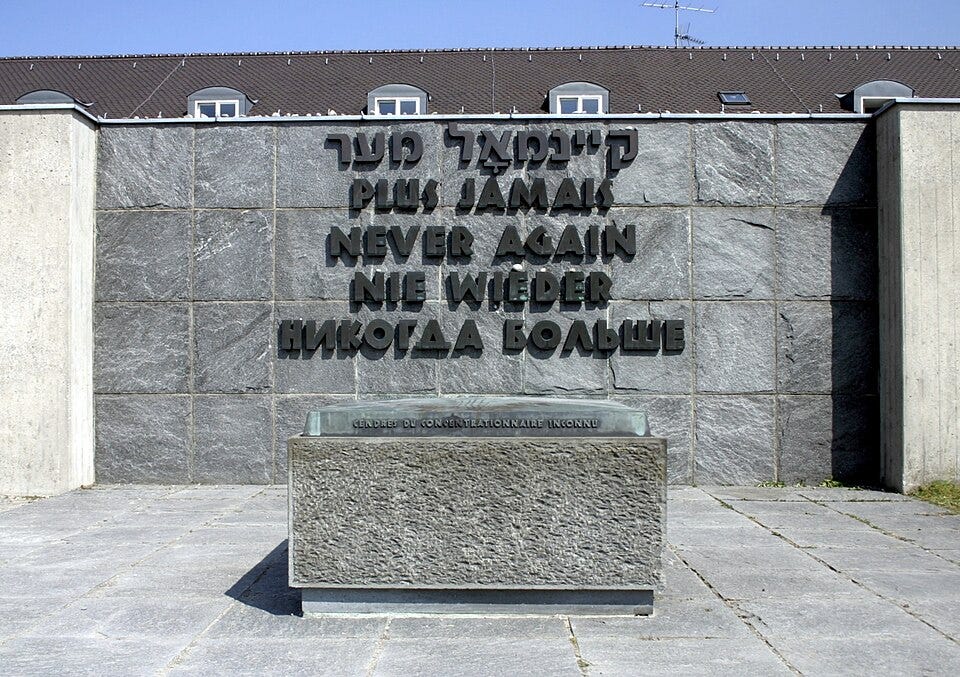
When the leaders of the most important academic institutions in the United States either failed or refused to clearly defend their Jewish and/or Israeli students, it sent a strong signal to colleges and universities elsewhere. Over 400 anti-Semitic ‘incidents’ occurred on US campuses during the first two-and-a-half months after October 7 (more than 3,200 nationwide). This represents a seven hundred percent increase in such so-called incidents since 2022.2 However, the article just cited concludes: ‘Colleges and universities can better meet the needs of Jewish students by expanding mental health services and resources and hiring counselors trained in culturally responsive therapy’.
Seriously?
When a Jewish student at Tulane is assaulted with a flagpole for trying to stop the burning of an Israeli flag, another at UMass Amherst is punched in the stomach for holding an Israeli flag, a third at Columbia is beaten with some kind of stick after confronting someone for ripping down posters of missing Israeli hostages, a professor at Stanford singled out Jewish students to illustrate a pro-Palestinian argument while telling them that only six million Jews were murdered in the Holocaust, and two Jewish students at Ohio State were attacked for verbally acknowledging their Jewish-ness, the best that American academia can do is offer these students therapy?3
These are the same institutions providing ‘safe spaces’, DEI training, and bending over backwards to protect every other student group—except Jews and Israelis somehow didn’t qualify for the same kind of protection. The strong disciplinary measures that might have been expected, such as those taken against Shai Davidai at Columbia, never entered the administrative imagination at these institutions.
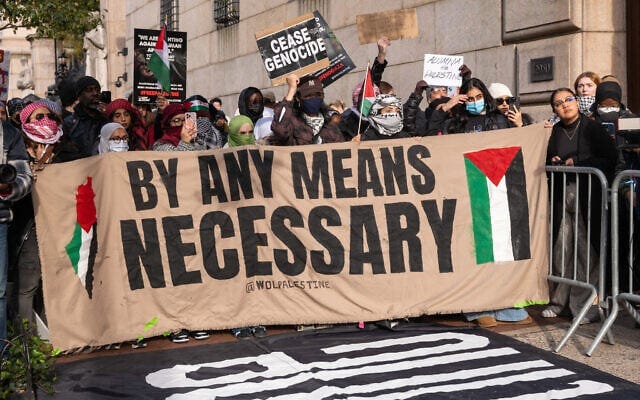
Then, I watched as the protests proliferated in many cities around the world—always in favor of Hamas, justifying Palestinian ‘freedom’ at the cost of Israeli blood, and chanting slogans reflecting the same genocidal ideology as devastated Europe in the 1930s and 40s. The moral lines could not have been clearer, and yet it seemed the only ones speaking out about any of this were Jews themselves. Meanwhile, the voices of victims and witnesses alike were drowned out by a strange silence—all the rest of us going about our business while quietly muttering, ‘Well, it’s a complicated situation’.
I watched all of this in shock, shame, and disgust as anti-Semitic rhetoric gave way to violence in places I knew (at one time or another) as home: specifically Boulder, Colorado and Manchester in the UK. It was happening on a scale I’d only read about in books about Hitler, Nazi Germany, World War II, and the Holocaust. What was supposed to be a solemn promise to the Jewish people and to ourselves—‘Never Again’—turned out to be just another meaningless slogan.
There were several un-related reasons I began to step away from academia, despite working so hard in that direction (along with all that my wife and our families did to support us). But I began despising the very idea of being an academic, and being associated even in my own mind with those professors and students cheering and excusing the atrocities as though somehow it was only what Israelis and Jews deserved.
I drew my own line in the sand, convinced that ‘Never Again’ ought to mean exactly what it says and that all lives were worth protecting. I could not bear to be seen as having any part of academia’s cowardly and hateful response, and so I stopped thinking of myself as one of them. I stopped trying to associate with most of them. I quit applying for academic jobs altogether, and stopped looking for seminars and conferences to attend. I distanced myself from people with whom I knew this to be an area of strong disagreement between us. For me, it wasn’t a matter of ideological disagreement so much as incompatible concepts of right and wrong.
Why do I still keep those three letters, Ph.D., behind my name? There are some days when I’m not entirely sure. On the whole, however, I have hope that academia is not irredeemably abandoned to its own structural evils. Those letters are a quiet personal reminder that I should strive to be among the ‘good ones’ even as I want nothing at all to do with any who would say or do anything that is in the least bit supportive of anti-Semitism, terrorism, or at all reflective of ‘those who call evil good and good evil, who put darkness for light and light for darkness’ (Isa. 5:20).
I am not Jewish. I don’t have any Jewish family or friends. I don’t know anyone Jewish. I’ve never been to Israel, and have no direct stake in what happens there. Jews and Israelis don’t need someone like me standing up for them. But I still want to speak up, because I’m convinced of the need for more voices clearly naming right and wrong even while we must acknowledge genuine complexity.
Is Israel a wholly innocent nation, free of its own mistakes, excesses, and evils? No. Then again, no country is or could ever be. But did those raped, kidnapped, tortured, and murdered on October 7, 2023 deserve what happened to them? Did these things occur as an inevitable and just consequence of Israel’s establishment as a nation in 1948 and its ongoing existence ever since?
I firmly believe ‘no’. What happened that day was nothing other than evil. In fact, there are no words that sufficiently express the tangible darkness that crossed from Gaza into Israel on that day, spreading across the globe in the days, weeks, and months that followed. I want nothing to do with that darkness.
Douglas Murray concludes his important book On Democracies and Death Cults by writing ‘All my adult life I have heard the taunt of the jihadists. “We love death more than you love life.” … How could anyone overcome a movement—a people—who welcomed death, who gloried in death, who worshipped death? Was it not inevitable that against such a force, a feeble and sybaritic West could not possibly win? … “Choose life” is one of the most important commandments of the Jewish people. It is also one of the fundamental values of the West. They, and all of us, can win in spite of the enemy’s loving death. Because there is nothing wrong with loving life so much. It is the basis on which civilization can win’.4
Now, without regard to the survival or victory of Western civilization (an outcome I’m far less deeply invested than in the coming of God’s kingdom on earth), I think Murray has an important point worth serious consideration wherever one happens to stand concerning the history and politics of the Middle East. Choose life.
In saying ‘no’ to wrong, I want also to say ‘yes’ to what is right. I don’t merely want to reject death, but to actively choose life. I want to be willing to stand alone and pay any price in order to choose life over and over again. I want to support anyone else—regardless of any factor like religion, ethnicity, or ideology—who also aspires to choose life.
‘Choose life, that you and your children may live’.
—Deut. 30:19
Douglas Murray, On Democracies and Death Cults: Israel and the Future of Civilization (Broadside Books: 2025), 88-89. The examples provided by Murray are documented and can be independently verified.
Marilyn Cooper, ‘Hate Has No Place On Our Campuses’, Liberal Education (Winter 2024). Available online at: https://www.aacu.org/liberaleducation/articles/hate-has-no-place-on-our-campuses. Accessed: 10 December 2025.
All examples (plus others) listed at the beginning of the Cooper article cited above.
Murray, On Democracies and Death Cults, 196-197.